Power steering
Please note: power steering adjustments are prohibited during the warranty period
1. Apply the parking brake or move the automatic transmission selector to position "P". Place the front axle on stands. The steering wheels must be raised.
2. Remove the engine protection.
3. Disconnect the longitudinal steering rod from the steering knuckle.
4. Check the steering wheel turning force.
5. Adjust the steering gear.
Notes:
- 1) Only a check is made for the absence of play in the engagement when the steering gear is in the central position.
- 2) If the steering wheel is not positioned correctly when the steering gear is in the central position, move the steering wheel.
6. When selecting the clearance in the engagement, swing the pitman arm in a near-central position, slowly turn the steering gear adjusting screw.
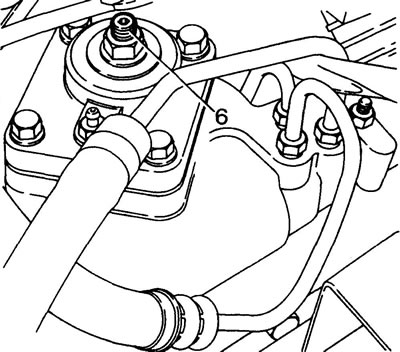
7. After selecting the clearance, tighten the adjusting screw lock nut.
8. Recheck the adjustment.
9. Turn the steering wheel from lock to lock. Check for an increase in rotational resistance.
10. When the steering gear is in the central position, the steered wheels should be in a straight-ahead position.
11. Adjust the length of the tie rod. The distance between the centers of the ball joints should be 924 mm.
12. Connect the longitudinal rod. Tightening torque 40 Nm.
13. Conduct a road test.
14. If the car pulls to the side, the longitudinal traction adjustment is incorrect.
15. Adjusting the longitudinal traction:
- Right-hand drive models: If the steering wheel pulls to the right, the rod is too long and vice versa.
- Left-hand drive models: If the steering wheel pulls to the right, the linkage is too short and vice versa.
16. Adjust the length of the rod until the vehicle no longer pulls.
Comments on this article