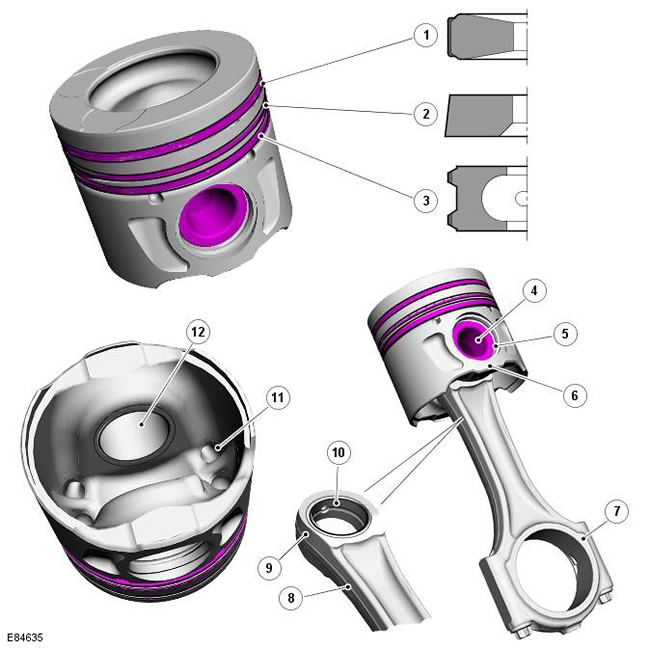
| Pos. | Spare part number | Name |
| 1 | - | Upper compression ring |
| 2 | - | Lower compression ring |
| 3 | - | Oil scraper ring |
| 4 | - | Piston pin |
| 5 | - | Piston pin retaining ring (2 pcs.) |
| 6 | - | Piston assembly with connecting rod |
| 7 | - | Lower connecting rod head |
| 8 | - | Connecting rod body |
| 9 | - | Upper connecting rod head |
| 10 | - | Connecting rod upper head bearing |
| 11 | - | Piston bottom cooling channel |
| 12 | - | Piston bushing (2 pcs. per piston) |
The connecting rods are made of forged steel and have an 'I' shaped body design, which ensures high strength and durability. The upper head of the connecting rod is tapered on each side, forming a cone. The conical shape improves the distribution of forces between the piston and the connecting rod during the combustion stroke. A bronze bushing is installed on the upper head, it has an internal groove that allows lubricating oil to flow around the bushing.
The connecting rod lower head is cut and machined at the joint, forming a bearing housing and a bearing cap, which is secured with two bolts. The cylinder number is stamped on the mating surfaces to identify paired connecting rods and bearing caps. Each half of the connecting rod lower head contains a bearing shell. The connecting rod bearing housings and shells have protrusions that ensure correct alignment of the bearing position in the housing and eliminate radial movement of the bearing shells. When installing, the protrusions should face the left side of the engine (towards the oil filter side).
To maintain the required clearance in the crankshaft connecting rod bearing, bearing shells of different thicknesses are provided. The lower bearing shell is offered in only one size option, the upper bearing shells have three size options.
For additional information on installing connecting rod bearings, refer to the appropriate Service Repair Procedures (SRP) manual.
The pistons are made of aluminum alloy and are equipped with two compression rings and an oil scraper ring with a spiral spring. A steel insert is inserted into the groove of the upper piston ring for reinforcement. The piston crown has a toroidal shape with a pronounced cup-shaped section in the center of the piston head. The piston crown also has recesses that provide space for four valve heads. The combustion chamber design helps achieve a high level of swirl and turbulence, which are required for complete combustion of the air-fuel mixture, as well as reducing the toxicity of engine exhaust.
Three piston rings must be installed so that the locks are located at a distance of 120° (with an acceptable deviation of 15° - 20°) from each other along the piston perimeter. The upper two compression rings are marked "Top" to facilitate installation. The lock of the trapezoidal oil scraper ring must be on the opposite side from the joint of the expansion coil spring.
The full-skirt piston is coated with a graphite-based compound that reduces friction in the cylinder. The graphite-based compound plays a particularly important role during the engine running-in period and during start-up. The piston also has two oil cooling channels located on the back side of the piston head.
On opposite sides of the piston skirt are two bushed holes for the installation of a fully floating piston pin. The piston pin passes through the bushed holes of the piston and the small head of the connecting rod and is fixed at both ends by a retaining ring. Oil is supplied to the piston, piston pin and small head of the connecting rod from an oil nozzle, which is located under each cylinder.
When installing pistons, the stamped arrow and 'DIST' designation on each piston crown must face the front of the engine (accessory drive end).
For additional information on piston and piston ring installation, refer to the appropriate Service Repair Procedures (SRP) manual.
Comments on this article